Back to Insights
Shifting your message to find new supporters: We tested what works, and here’s what we found.
Fewer people are signing petitions, contacting lawmakers, and showing up than a few years ago. Most organizations are covering the gap the only way they can: going back to the same supporters, again and again, and hoping they keep saying yes.
Somewhere out there is a large group of brand new people who would support your organization if you framed the ask a little differently. Testing is how you find out who they are, where they come from, and what they respond to.
As energy dips after the election, now’s the time to engage with your audience and grow your list before advocacy season kicks off in earnest this January.
Agile testing replaces this with evidence of what messages actually perform with an audience before you commit to a paid media budget or a big campaign push.
GrowProgress tested four different ways of describing Surfrider's work with people who weren't already familiar with the organization. Each person saw one message, then answered a short survey about whether they felt more aware of the issue, trusted the organization, and would take action or give.
Somewhere out there is a large group of brand new people who would support your organization if you framed the ask a little differently. Testing is how you find out who they are, where they come from, and what they respond to.
As energy dips after the election, now’s the time to engage with your audience and grow your list before advocacy season kicks off in earnest this January.
How do you develop the right value proposition for your audience?
You test it! The old way organizations figured out what to say was by gut instinct. But that only gets you so far. However skilled and experienced your team is, we’ve seen time and again that staff can misjudge what actually resonates with supporters.
Agile testing replaces this with evidence of what messages actually perform with an audience before you commit to a paid media budget or a big campaign push.
Here's what we tested
Surfrider Foundation is a nonprofit that protects the ocean, waves, and beaches through a national network of local chapters and volunteers. Like most organizations, they need to keep reaching people who have never heard of them, and the first message those people see decides whether they stick around.GrowProgress tested four different ways of describing Surfrider's work with people who weren't already familiar with the organization. Each person saw one message, then answered a short survey about whether they felt more aware of the issue, trusted the organization, and would take action or give.
Here are two of the sample messages
Message 1: People-Powered, Coast to Coast
The Surfrider Foundation isn't run from a boardroom -- it's powered by a national network of over 250 local chapters and student clubs who live in the coastal communities they're fighting to protect. When a threat shows up, from a polluted waterway to new offshore drilling, our volunteers are already on the front lines, organizing neighbors and pushing for change. That local knowledge, backed by national resources and legal expertise, is what turns ocean lovers into a force strong enough to fight, and win. Join the Surfrider Foundation's community and become a friend of the ocean today.Message 2: 862 Million Pieces of Plastic, Gone
The scale of plastic pollution in our ocean can feel like an impossibly overwhelming problem to solve, but in 2025 the Surfrider Foundation removed the equivalent of 862 million single-use plastic items from circulation through 14 hard-won state and local policy victories. This is more than just beach cleanups -- they're powerful legislative reforms that stop plastic from reaching the ocean in the first place. Every plastic pollution law we help pass adds up to real, positive change on your beach. Join our fight to keep plastic pollution out of the ocean by becoming a member of the Surfrider Foundation today.What won
"862 million pieces of plastic" was the clear winner. It started by admitting that ocean pollution can feel too big to fix, then answered with concrete results: court cases, state and federal legislative wins, and nearly a billion pieces of plastic kept out of the ocean.Why it matters
People are tired of vague petition language. Filling out a form usually means joining another email list, so give them a reason that feels worth it: the specific problem and what you're actually doing about it. Real numbers beat broad appeals.What winning advocacy pages have in common.
We put this theory to the test. We reviewed over 1,068 high-performing campaign pages on AdvocacyAI. Here is what winning pages have in common:1. Name the action and the decision maker in the headline
Pages that named the specific decision maker organizations wanted supporters to contact converted at three times the rate of general messaging about supporting an issue. Start the headline with a verb for the action, such as tell, urge, email, call, or sign.2. Set a deadline
Pages with time-bound language, such as "do this by" a date or "this is happening Friday," converted between 25 and 40 percent.3. Describe what is at risk
Headlines built on words like stop, reject, don't let, ban, hands off, and protect accounted for about 61 percent of actions. Headlines built on support, create, authorize, enact, and help accounted for about 33 percent.4. Use the word "your"
Among high-performing pages, those that used "your" converted at 8.8 percent, while pages that did not converted at 2.1 percent. It was the strongest single word in the data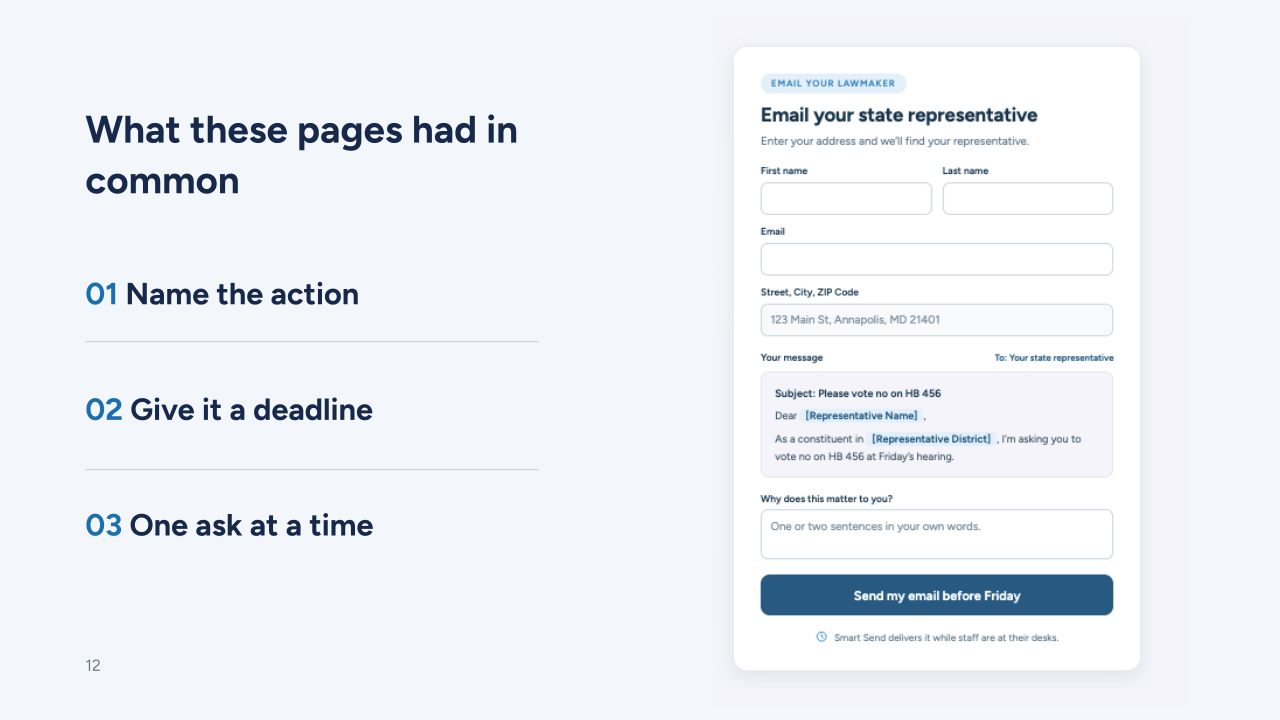
When it comes to testing, take bigger swings but make sure you can measure the results. Platforms like AdvocacyAI make this easy to launch multiple versions of a landing page right within the platform and send each to a different segment of your list.
Get more details on this message test and how you can apply the takeaways to your own advocacy program by watching the full webinar.
Watch: Shifting your message to find new supporters
Get the webinar recording