Back to Insights
The Advocacy Engagement Ladder: How to Turn One-Time Actors Into Long-Term Champions
Grassroots Advocacy
Ada's TL;DR digest
An engagement ladder is the structure your program runs on every day, the same way a CRM structures a sales team's pipeline — never a project you check off and close. Build the rungs, automate the triggers between them, and your list stops being a number that grows and becomes a roster of people moving somewhere specific.
I can usually guess a programs numbers before I see the dashboard: 5 to 7% of their list is doing 80% of the work, and the rest took one action and vanished. If that's your program, you're not doing anything wrong. That's just the ladder of engagement.
A government affairs colleague I worked with years ago described the goal better than I can: making your "grassroots grass grow taller". Your goal should never be collecting as many blades of grass as possible. You're trying to get the ones you have to grow.
A ladder of engagement is a working structure for grassroots advocacy that tells you who's ready for a bigger ask, who's drifting, and who you should stop emailing entirely.
What an engagement ladder actually is
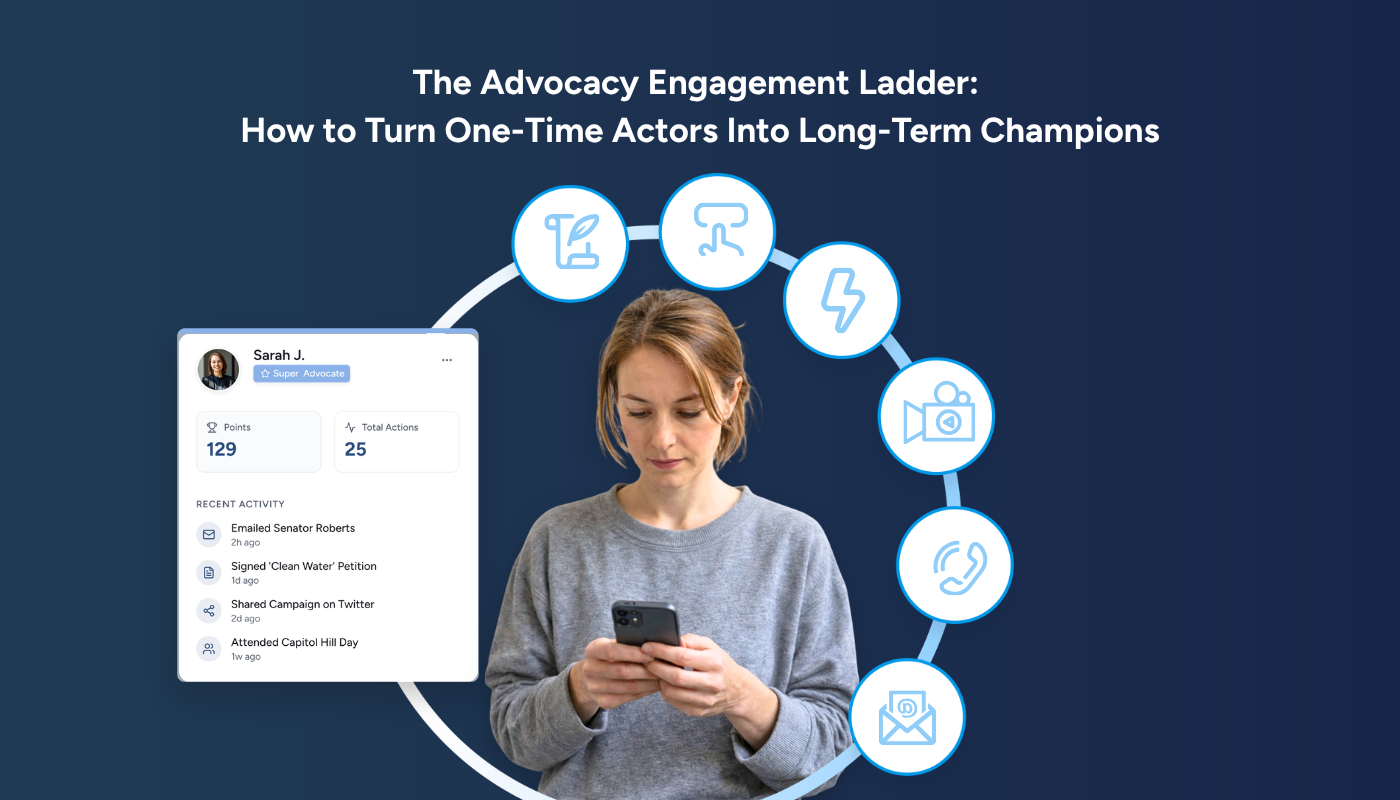
An engagement ladder is a structured sequence of progressively deeper commitments that moves a supporter from awareness to action to advocacy to leadership. Each rung represents a different relationship with your cause.
It is not a funnel. Funnels end. Someone converts, and the funnel's job is done. A ladder doesn't end — a supporter can climb it for years, plateau, drop a rung, and climb again. The whole point is that the relationship keeps moving.
A practical version of the ladder looks like this:
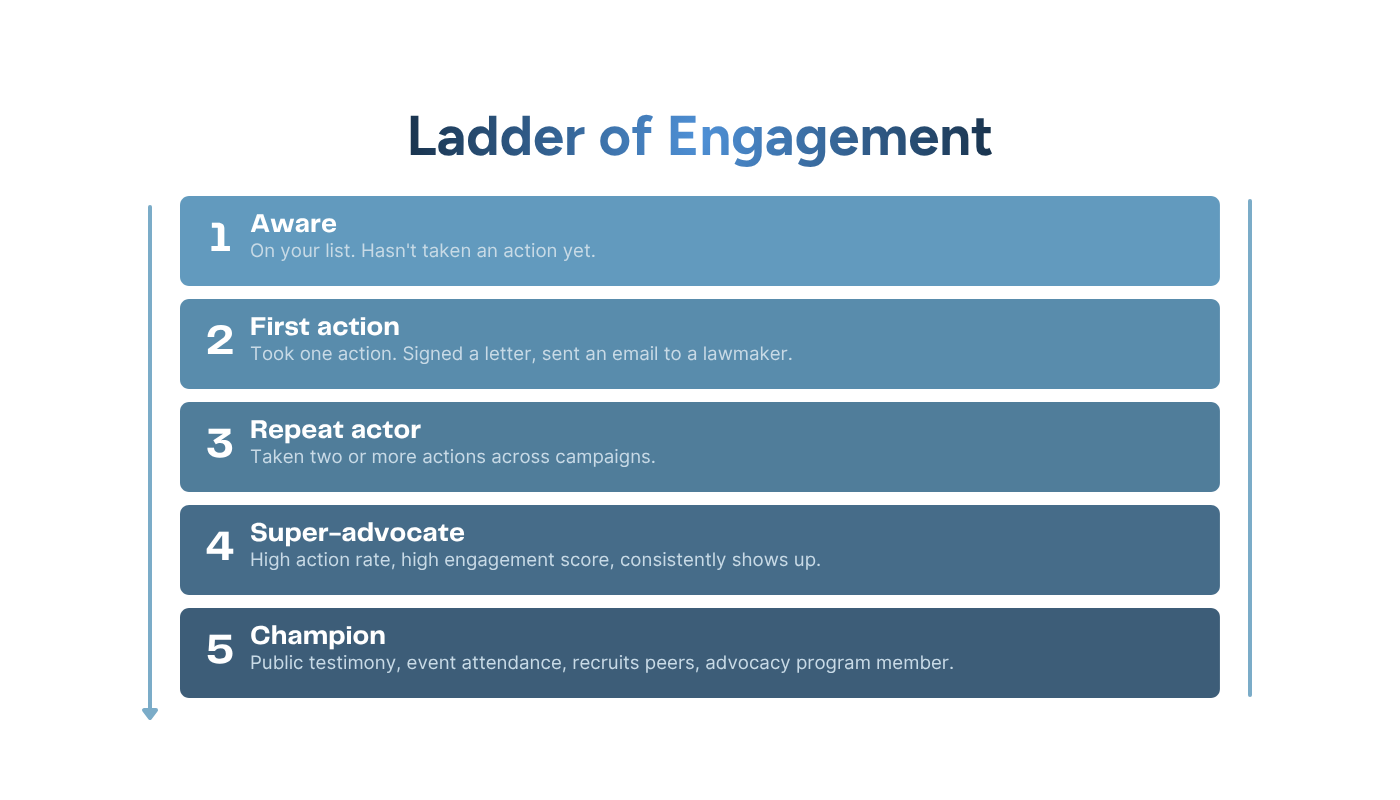
How to identify where your supporters are on the ladder right now
How to identify where your supporters are on the ladder right now
Your platform almost certainly already has the data to place every supporter on a rung. What's missing is defining what you want that ladder to be.
Five data points get you there:
- Total actions taken (across the full relationship, not just the last campaign)
- Recency (a supporter who took five actions two years ago isn't a super-advocate anymore, no matter what their lifetime count says)
- Depth (did they click one generic action, or are they taking higher value actions like attending events or making calls)
- Engagement score (open and click rates on what you actually send them)
- Profile completeness (do you know their district, their legislator, their vote history).
Try answering these five questions right now, without pulling a report. How many of your supporters have taken more than one action, ever? Who hasn't acted in over six months? Which 20 supporters have the highest action count, and have you ever spoken to them directly? What share of your list do you have full profile data on? If you had to name your five most likely future champions today, could you do it without guessing?
If you got through two of those from memory, you're ahead of most advocacy directors I talk to.
Moving supporters up — what to ask for at each rung
Moving supporters up — what to ask for at each rung
This is where the ladder earns its keep. Each transition needs a specific ask, not a generic "stay engaged" nudge.
| Rung Transition | Ask Type | Channel |
|---|---|---|
| Aware → First action | Low-friction, single-click action (email a lawmaker, sign a letter) | Email, SMS |
| First → Repeat | Related ask, same issue, different angle, sent while they're still warm | Email, follow-up SMS |
| Repeat → Super-advocate | Deeper ask — share a story, complete a survey, request a constituent meeting | Email, phone, video |
| Super → Champion | Peer-to-peer ask — invite colleagues, speak publicly, take a local leadership role | Personal outreach, event invite |
Aware-to-first-action has to be frictionless: one click, one field, done. This is not the place to ask for a phone number you don't need yet.
First-to-repeat is about timing more than content. Someone who just acted is statistically more receptive to a second, related ask within days than they will be a month later. Wait too long and the moment's gone.
Repeat-to-super-advocate is where you finally ask for something beyond a click. "We noticed you've taken action three times this session — would you be willing to share your story?" works because it acknowledges what they've already done. Nobody wants to be asked for depth before anyone's noticed they showed up.
Super-to-champion is peer-to-peer: invite three colleagues to take action, fill a speaking slot, take a local leadership role. By this rung, your supporter is doing some of your organizing for you.
None of this scales if a human has to remember to send it. The timing and content of each ask should trigger automatically based on where a supporter sits on the ladder. A platform that sends to a list on a schedule is a delivery tool. A platform that fires the right follow-up the moment someone crosses a rung is managing a program.
Re-engaging supporters who stopped climbing
This is the 80% nobody wants to talk about honestly. Someone took one action, and then nothing. What do you actually do?
Send the same ask with a different subject line and call it a "win-back" sequence, and you haven't changed anything except the date. That's what most re-engagement campaigns actually are: more emails, not real re-engagement.
A real re-engagement sequence runs two or three touches with a progressively softer ask. The first touch shouldn't ask for anything — it should report back. "Here's what happened since you last helped us" does more for trust than another call-to-action ever will. People act once and then watch the silence that follows. If they never hear what their action led to, they have no reason to believe a second one matters.
I made this same argument in a guide I co-wrote with Henri Makembe and Christina Kuo on prioritizing state and local advocacy: engagement ladders need off-ramps built in, not just escalation steps. Not ready to call? Send the email now instead. A soft ask that gets a yes beats a hard ask that gets ignored, every time.
There's also a threshold where you stop. After 6 to 12 months of inactivity, call it what it is. A supporter who hasn't acted in a year isn't dormant, they're inactive, and treating them otherwise wastes sends and damages your deliverability.
And know that some supporters were never going to be more than a single action and that's ok. Convention of States built a petition list of roughly 2.4 million signers, and only about 10% of them were ever active beyond that first signature. Stop burning list health trying to revive people who signed once for reasons that had nothing to do with becoming a repeat advocate. Suppressing them from sends moving forward will reward your program.
Why this only works if your data stays connected
Why this only works if your data stays connected
None of the above works if a supporter's history lives in five different campaign exports. A ladder needs a single profile holding everything a supporter has ever done, every action, every campaign, every channel, in one place that updates in real time.
If your platform can't tell you, on demand, that someone took two actions last spring and one last month, you're not running a ladder. You're running disconnected campaigns and hoping somebody notices the pattern by hand. That doesn't survive contact with a real list size. Platforms built for program management rather than just delivery track this automatically, because at any meaningful scale a human can't.
Frequently Asked Questions
A ladder of engagement is a framework for categorizing supporters by depth of participation and moving them progressively toward higher levels of commitment. A campaign metric tells you what someone did once. A ladder tells you where that relationship stands over time — from a first action to long-term championship.
Sequence the asks instead of treating them all the same. Start with a low-friction action — emailing a lawmaker, signing a letter — to get someone onto the ladder at all. Follow up quickly with a related ask while they're still warm. Supporters who take a second action within the first 30 days are far more likely to become long-term advocates than supporters who take one action and hear nothing for months.
Give them something between asks. Updates on what their action led to. Stories from the field. Progress reports on the bill or issue they helped move. Supporters re-engage when they believe their first action mattered — so show them, don't just tell them.
Grassroots organizing is building political power through the collective action of individual community members rather than through institutional or lobbyist pressure. In advocacy, it means recruiting and mobilizing supporters directly — to contact lawmakers, attend events, or publicly back a position — rather than relying solely on paid advocates or executives.
Look at three signals together: frequency (how often have they acted), recency (when did they last act), and depth (have they done more than fill out a form — called, written a personal letter, given public comment). Supporters who score high across all three are your super-advocates, and they're worth the personal outreach, the bigger ask, and the leadership opportunity.
The Takeaway
The Takeaway
An engagement ladder is the structure your program runs on every day, the same way a CRM structures a sales team's pipeline — never a project you check off and close. Build the rungs, automate the triggers between them, and your list stops being a number that grows and becomes a roster of people moving somewhere specific.
Start small. Pull your data this week and find out how many of your supporters have taken more than one action. That single number will tell you more about the health of your program than your last three open rates combined.
A ladder of engagement is a working structure for grassroots advocacy that tells you who's ready for a bigger ask, who's drifting, and who you should stop emailing entirely.