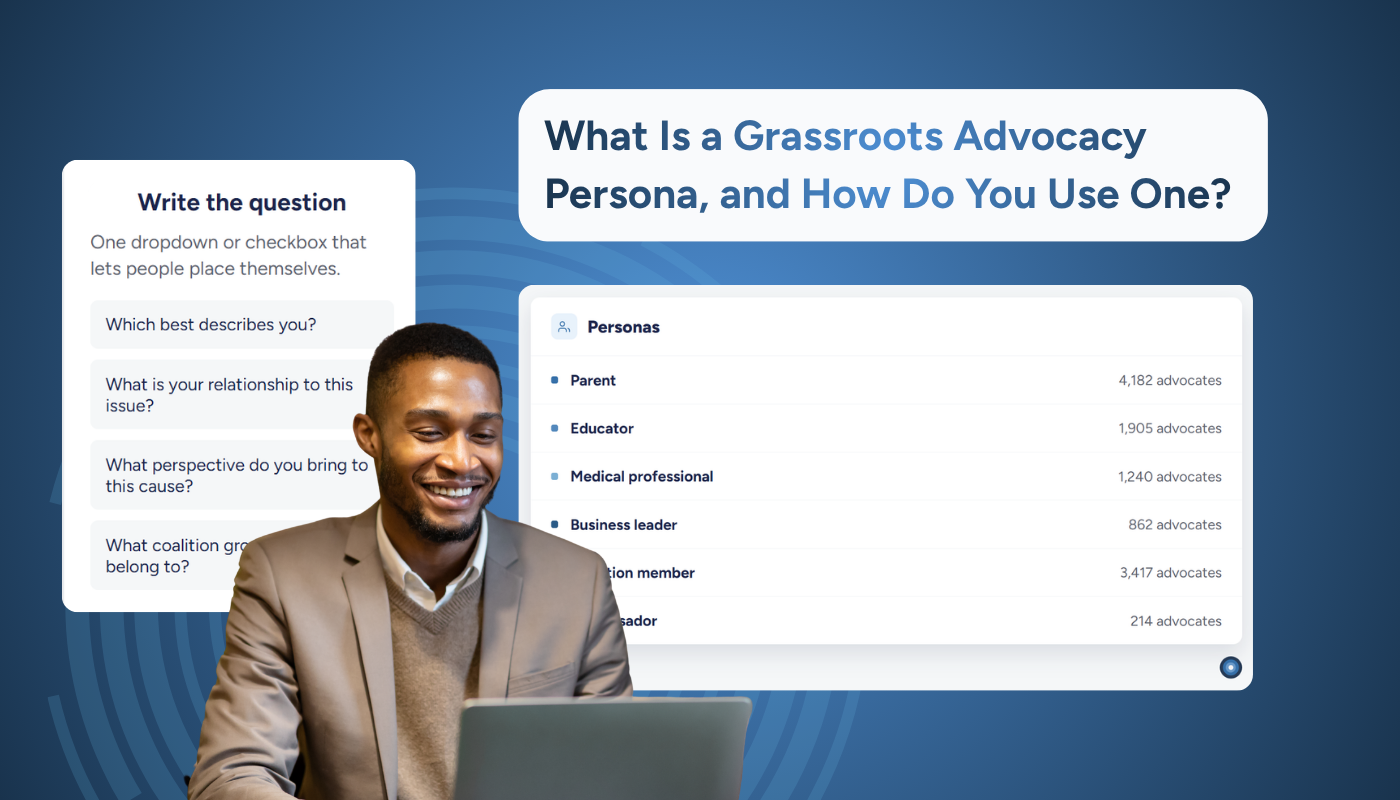
In advocacy, personas help you drive more engagement by reaching different groups with the messages, issues, and actions most relevant to them. And ensuring the way they communicate with lawmakers captures their unique perspective of an issue.
An advocacy persona is a group within your list of members or supporters that you define and can act on:
Parent Educator Medical professional Business owner Coalition member Issue expert
Whatever is relevant to your issue or cause.
In the for-profit world, personas are used to segment audiences, consider an audience's interests, and drive more sales based on different needs, motivations, and behaviors.
In advocacy, personas serve a similar purpose: helping you drive more engagement by reaching different groups with the messages, issues, and actions most relevant to them. And ensuring the way they communicate with lawmakers captures their unique perspective of an issue.
Start with the strategy.
Using personas in your advocacy programs is not a huge data project. The most important part is deciding the answer to one question:
"If you could tell the different groups in your list apart, what would you do differently?"
That answer is your persona list. Two groups is enough to start. Ten is plenty. One group with fifteen people in it can be the most valuable one you have.
Three of the most common ways organizations draw those lines:
Company, coalition, or chapter affiliation
Who does this person belong to besides you? For associations this is often the member company. For coalitions it is the partner organization. For chapter-based nonprofits it is the local affiliate.
Affiliation is the persona that makes shared campaigns work. Without it, everyone who takes action through a coalition page arrives as an anonymous name on a list, and no partner can see their own people in the results.
💡Idea in practice: A business coalition used personas so advocates taking action through a shared campaign could identify which organization they came from and why the issue mattered to them. Every partner could see their own participation instead of a single flattened total.
Area of expertise or personal connection
What does this person know, and what is their stake in it? A clinician, a patient, a parent, and a researcher all care about the same bill for different reasons, and each of them makes an argument the others cannot.
💡Idea in practice: A national rare disease association added one question to their surveys and action pages: what is your relationship to this condition? (Person with the disorder, parent, partner or spouse, medical professional.)
Nothing else about the workflow changed. What changed was their ability to write to parents as parents and to bring a clinician forward when a clinician was what an office needed to hear from.
Influence with lawmakers
Who on your list already has a relationship with an office, employs people in the district, or sits on a board that a member of Congress pays attention to?
This is the persona that changes programs the fastest. Once you know who your business owners are, who has met their representative before, and who has testified, you can:
Build Hill day and district visit invitations from a real list instead of a guess
Staff an ambassador or leadership program with people who already qualify
Change the message these advocates send, since an office weighs a letter from a local employer differently than a form email
What personas do for your team
Get more engagement from your list
Someone who joined because of access to care may respond very differently than someone focused on workforce shortages or local economic impact. Personas let those supporters hear from you in the context that is most relevant to them.
Build more influence with lawmakers
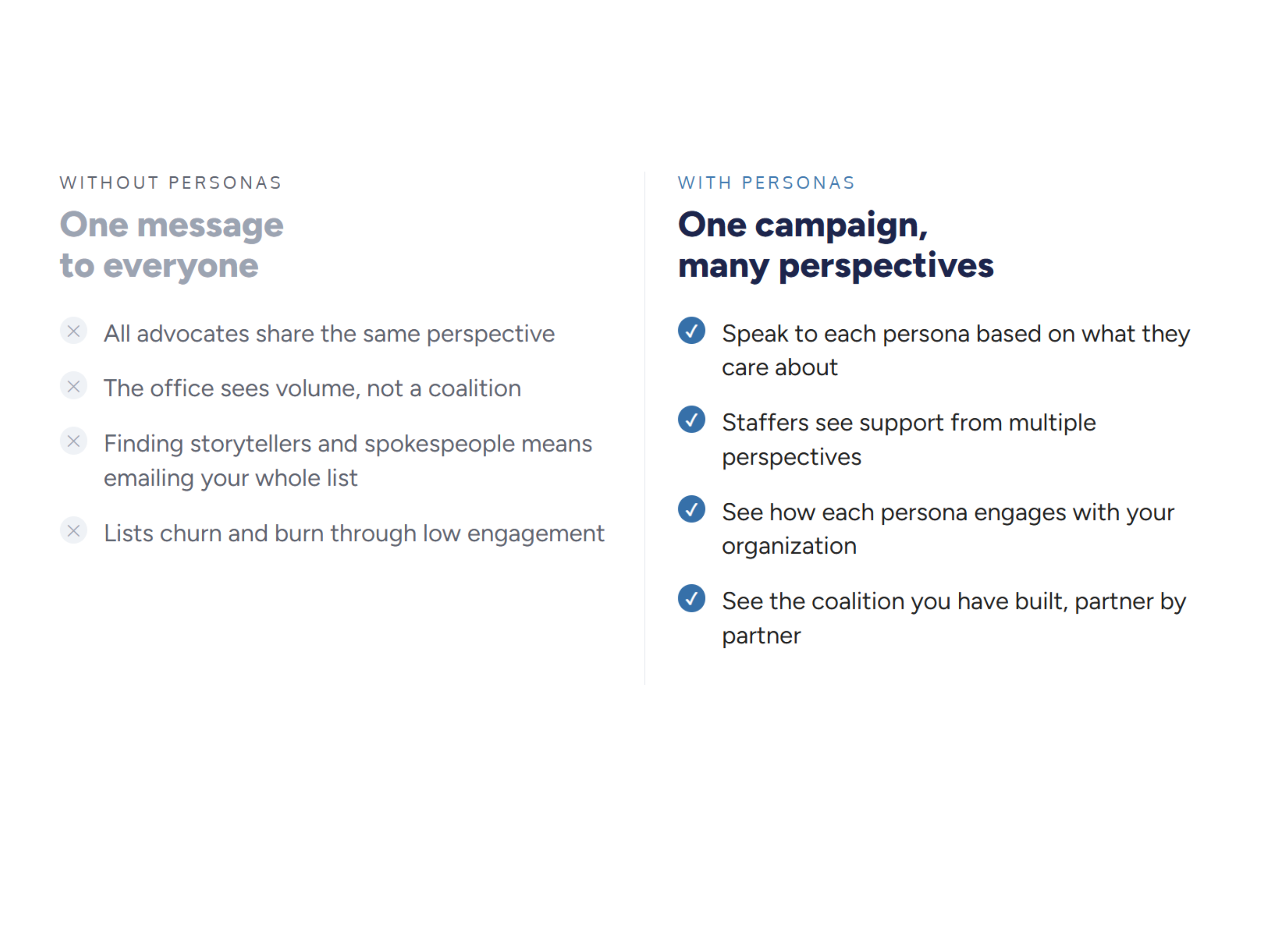
AdvocacyAI can automate which emails advocates see and send based on their persona. Instead of an office receiving 40 versions of the same message, it can hear 10, 20, or 40 different perspectives on the same issue.
Save your staff time
When your team needs a testimonial, a personal story to pitch to the media, or someone who can show up in a legislative office, personas make it easier to identify the right champions and perspectives already in your database instead of emailing everyone and hoping someone raises their hand.
Report on your impact across an entire coalition
One national corporate coalition created a custom field for each of more than 4,000 local businesses in its network, allowing advocates to identify themselves and their business when contacting lawmakers. That made it possible to understand participation across the coalition by company, location, and advocate rather than only looking at a total action count.
How to let your advocates tell you who they are
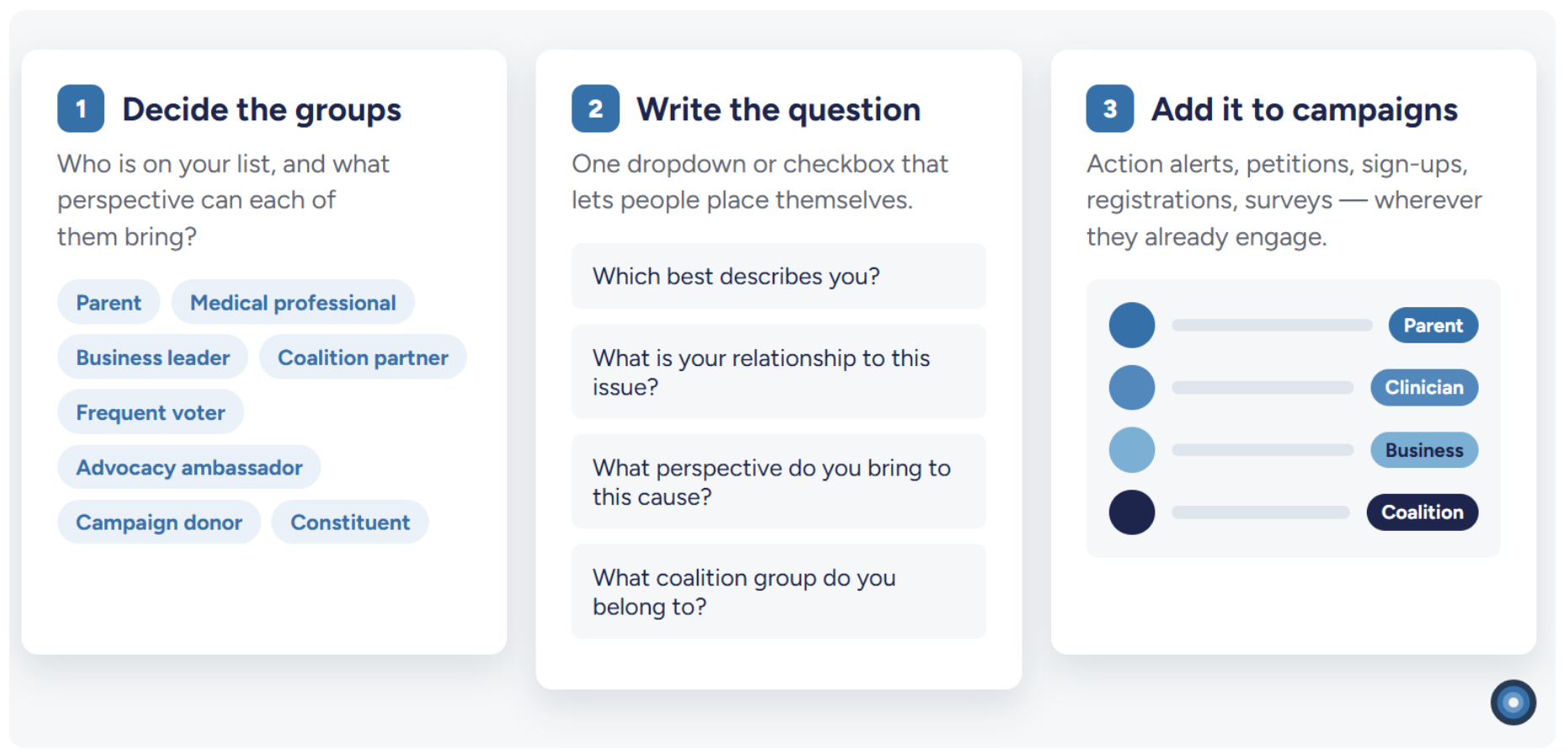
This does not need to be a complicated survey or a CRM overhaul. Making personas part of your program comes down to three steps:
1. Decide what you want your personas to be. Answer the questions:
If you could tell the different groups on your list apart, what would you do differently?
Which perspectives on your issue would be especially valuable for lawmakers to hear from?When your team needs the right advocate quickly, who are you usually trying to find?
Are there affiliations, chapters, companies, or partner organizations you need to track separately?
Which people on your list have relationships, experience, or credibility that make them especially useful in certain advocacy moments?
2. Decide what question someone would answer to tell you which one they are. One dropdown or checkmark box to identify what persona you want them to fit in.
3. Put that question where they already interact with you. Action alerts, petitions, newsletter sign-ups, event registrations.
That third step is what keeps it from becoming a project. The question becomes a part of your regular infrastructure and strategy on an ongoing basis.
Idea in practice A solar energy advocacy campaign added one field to their action form: do you live near the project site, or do you live elsewhere in the state and care about its impact? That single question changed what supporters could say in their message to lawmakers, and it surfaced the people close enough to show up at a city council meeting.
You can also build personas without asking anything. Give each audience its own landing page link, and everyone who arrives through that link joins that group. A page for labor leaders and a page for corporate coalition members can sit under one campaign.
Your action alerts stop reading like they were written for a general audience using policy wonk language and instead speak to individuals. The same alert can carry a different opening line and a different ask depending on who opens it. The message itself changes too. A parent writing about their kid and a business owner writing about payroll make different arguments about the same bill, and a legislative office reads them differently. One campaign produces both.
Email
Email is usually where personas start paying off because it is where one-size-fits-all outreach gets expensive fast. Someone who signed their first petition last week probably needs a simple next step; someone who has testified twice may be ready for a legislative meeting, a story request, or a leadership role. Personas let those people move through different journeys instead of receiving the same sequence.
Social media
Personas can also show you whose perspective is missing from your content. If most of your engaged supporters are patients, local employers, or volunteers, but your social feed is written almost entirely for policy professionals, that gap becomes easier to see and correct.
Website and ambassador programs
Ambassador, champion, and leadership programs are often persona programs in practice. Once you know who has already shown up, spoken publicly, recruited others, or taken on more responsibility, you have a much better starting point for deciding who to invite into the next level of engagement. The same idea can shape what returning supporters see on your action center or website.
Paid ads
Paid ads already start with audience segmentation. Personas make sure that segmentation does not disappear after the click. Someone who responds to an ad aimed at small business owners can land on a page written for that audience and enter your database already identified as part of that group.
How AdvocacyAI builds personas
Personas run on custom fields that you control.
Supporters join a persona when they take action, on an action alert, a petition, a survey, or an event registration, so no one has to be recruited into a separate survey campaign. You can also skip the question and give each audience its own landing page link, with everyone who arrives through it joining that group. Both approaches live inside one campaign and take about ten minutes to set up.
Once a persona exists, it drives your landing page content, your email journeys, your CRM, and the message an advocate sends to their lawmaker.
One thing we do not do: generate advocate messages with live AI at the moment of send. If a business owner arrives on your page ready to email their representative, the question of what argument moves that office is a strategy decision, and it belongs to the person who knows the issue. The platform drafts a version for each persona, your team approves each one, and then they go live. Each letter or email your campaign produces ultimately comes from human strategy, even if AI helps get you there.
Frequently Asked Questions
An advocacy persona is a group inside your advocate list that you define, such as parent, clinician, business owner, or coalition partner. Supporters join a persona by answering a question on an action page, petition, or survey, or by arriving through a landing page built for that audience. Once a supporter belongs to a persona, that group can drive the email they receive, the page they see, and the message they send to a lawmaker.
Between two and ten is a workable range for most programs. Start with the groups you would treat differently if you could tell them apart. A persona with fifteen people in it is worth creating if those fifteen people are the ones you call when a committee needs a witness.
No. Personas run on custom fields, and the question that assigns them can live on an action alert, a petition, a newsletter sign-up, or an event registration. Supporters answer while they are already taking action.
A segment is usually a filter you apply after the fact. A persona is a group your supporters place themselves into at the moment they engage, which means it stays current and can drive content and automation without anyone maintaining it.
Yes. When a persona drives message content, one campaign can produce several arguments about the same bill, each written for the kind of person sending it. Legislative offices weigh a message from a local employer differently than a form email, and personas are how that distinction reaches the office.